

The Night of Power 2024: How Muslims spend their last 10 days of Ramadan, prepare for Eid al-Fitr
- The Manila Warden
- May 20, 2024
- 4 min read

Updated: May 23, 2024
April 18, 2024

Grand Imam Jalal Jamil of Masjid al-Dahab gives away sponsored Pocari Sweat energy drinks to fasting Muslims an hour before Iftar during a Monday afternoon on April 8. (Photo by Aabgina Cos/The Manila Warden)
As the holy month of Ramadan ended and Eid al-Fitr comes after, Muslims look forward to Laylat-ul-Qadr, or the last 10 “Nights of Destiny” of the sacred month, as they devote themselves to the worship of Allah through tahajjud, the supplementary prayers after midnight before Salat al-Fajr, the first prayer of the day.
During this time, Muslims believe that the Night of Power happened within the odd nights of those 10 evenings, although traditionally thought to take on the 27th night of the sacred month, even when the exact date is unclear.
With unique traditions and sacred intentions in place, it is important to seek the significance of how Muslims use their time during the holiest nights of Ramadan.
Understanding the Night of Power
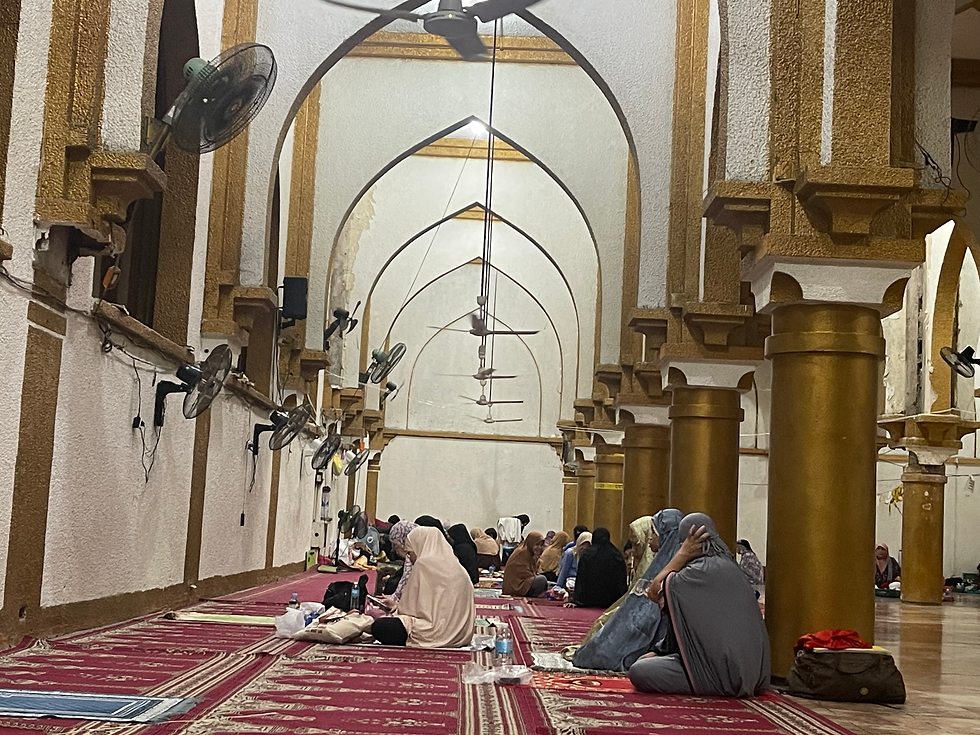
Muslimahs in the female section of Masjid al-Dahab wait patiently around 6 PM for the call of prayer of Salat al-Maghrib to have Iftar on Monday, April 8. (Photo by Keonna Atienza/The Manila Warden)
Although the holy month in entirety is a special time for Muslims in Islam, the last 10 nights hold a greater significance as it also holds the Night of Power where the Holy Qur’an was revealed and sent down to Prophet Muhammad by angel named Jibril (Gabriel).
Jalal Jamil, the Grand Imam of Masjid al-Dahab or Manila Golden Mosque, also emphasized the importance of Laylat-ul-Qadr and how it holds the most mercy and forgiveness from Allah through one’s good deeds and words.
“Ayon po sa sinabi ng Propeta [Muhammad]—Man qama Laylat-ul-Qadri imanan wahtisaaban, ghufira lahu ma taqaddama min zambih (Whoever stands up for the Laylat-ul-Qadr with firmness of belief and stock taking of his deeds, then all his past sins are forgiven),” Jamil said.
“Sino man ang magsagawa ng mga magubating gawain sa gabi ng Laylat-ul-Qadr, [...] ito ay ipapatawad sa kanya ng Allah Subhana wa ta’Allah (God, The Most Glorified), ang kanyang mga naunang kasalanan,” he explained.
During those blessed nights, it is also known amongst Muslims that Allah descends to the lowest heaven close to Earth, according to Imam Muhammad al-Bukhari in his book, Sahih al-Bukhari, a collection of hadiths, or sayings and deeds of the Prophet Muhammad (PBUH), which is also known as the sunnah.
Jamil further said that Muslims usually get more involved in their devotion as they take the opportunity of the grace and blessings that they could receive during the last 10 nights, considering how the Night of Power within those nights carry the most rewards, grace, and virtues from Allah.
“Sinabi ng Allah Subhanahu wa Ta'ala sa Banal na Quran, [na] ang magagawa mong kabutihan dito [sa Laylat-ul-Qadr] ay mas mainam kumpara sa 1000 months o isang libong buwan,” he stated.
Muslims also perceive Laylat-ul-Qadr as an event where their annual destinies will be determined by their creator, which in turn encourages them to sacrifice their sleep to pray tahajjud, read the Qur’an, and repent through supplications to reach a high position in heaven.
Since the Nights of Destiny and the Night of Power are just before Eid al-Fitr, Muslims primarily perform the act of zakaat or almsgiving as it is known as the third pillar of Islam, which is obligatory upon Muslims to fulfill.
Specifically, they pay Zakaat ul-Fitr, also known as fitrana or donations, before the Eid prayer during the last few days of Ramadan. Usually, self-supporting adults pay their fitrana. Otherwise, the head of the household, such as parents or guardians of non-working or underage children, that have excess food must pay perform the charity.
Celebrating Eid al-Fitr

Thousands of Muslims stand in preparation for Salat al-Eid, a special prayer done only on Eid al-Fitr, during a Wednesday morning on April 10. (Photo by Christian Querol/The Manila Warden)
While Muslims feel the emptiness when the Ramadan ends, they celebrate Eid al-Fitr, or the “festival of breaking the fast,” as it comes as a new month known as Shawwal, which is the 10th month in the Islamic calendar. The joyous event is also known as the most favored Islamic festival among children, since they traditionally have family reunions and receive a variety of sweets, new clothing, and other gifts.
Grand Imam Jalal Jamil of Manila Golden Mosque, together with the Muslim community in Manila, highlighted the importance of the Islamic holiday and how it is more than simply a feast, especially for those who fasted during Ramadan.
“Bilang isang Muslim community, [...] ay ipaalam ang kahalagahan ng Eid al-Fitr sa mga Muslim o ipaalam ang mga mainam na gagawin after ng pagsagawa ng Eid al-Fitr o tamang pamamaraan bilang isang Muslim,” Jamil said.
“Kami po ay nag-organisa ng isang tinatawag na Farhat-ul-Eid o Eid celebration para sa ating mga kabataan,” he added.
In the official Facebook page of the Manila Golden Mosque and Cultural Center, they also announced in a post that the Eid celebration would happen after an hour of Salat ul-Eid, containing exciting games and prized for children present in the mosque.
“Special dito ang mga kabataan upang ipaalam sa kanila na dahil ang ibang kabataang Muslim ay hindi alam ang kahalagahan ng Eid al-Fitr o ano ang ginagawa sa Eid al-Fitr,” Jamil said.
He also mentioned that the purpose of the Eid celebration is for the children to know and understand Eid al-Fitr as an act of worship toward Allah and not just a fun tradition, especially as young followers of Islam.
Jamil further explained that the Eid prayer comes after Salat al-Fajr, which happens before sunrise around quarter to 5 AM. In Manila Golden Mosque, they held the Salat ul-Eid at 7 AM with around 3000 Muslims present.
With the greatest holy days put behind them in the meantime, the Grand Imam reminds Muslims of how the holy month Ramadan came as a teacher, doctor, and an opportunity for them to repent from their sins.
Meanwhile, he also urged Muslims, “ang mensahe ko po sa mga kapatid na mga Muslim ay ipagpatuloy po natin kung ano ‘yong natutunan natin sa pagdaan ng buwan ng Ramadan.”
Following Ramadan and Eid al-Fitr is the Eid al-Adha, or the “Feast of Sacrifice,” which celebrates the end of Hajj or the pilgrimage of Muslims to Makkah. In those holy days, Muslims around the world sacrifice and donate the meat of a sheep, goat, cow, or camel to reflect the willingness of Prophet Ibrahim (PBUH) to sacrifice his son, Ismail, for the sake of Allah.
The upcoming Islamic holiday will be held on the 10th day of Dhu al-Hijjah, the last month of the Islamic calendar, and it will last for three days, similar to Eid al-Fitr.
- Aabgina Cos


Comments