

Policy Expo 2024: Peace, public safety, political stability, climate change talks held at UST Research Center
- The Manila Warden
- Apr 28, 2024
- 3 min read

March 20, 2024
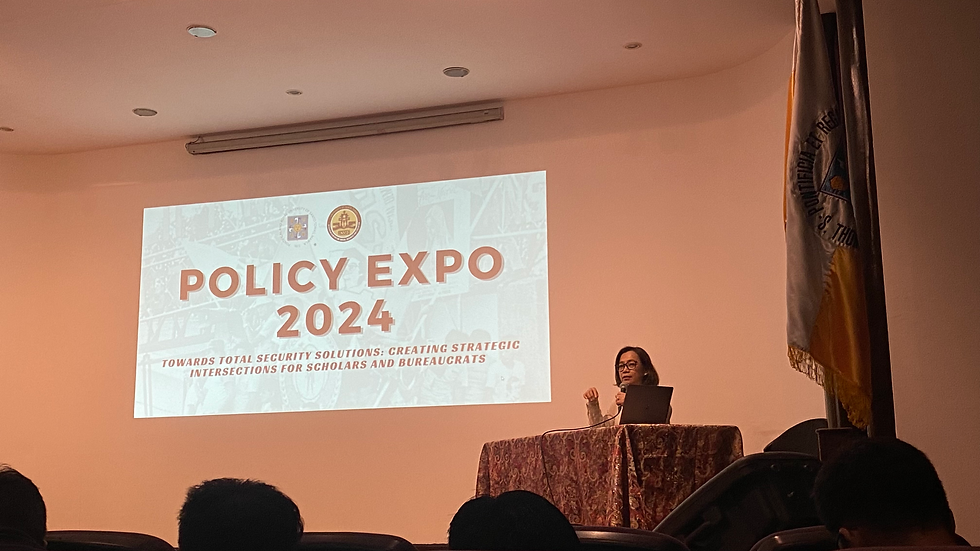
Dr. Perante-Calina discusses political stability and public safety as the last speaker of Policy Expo 2024. (Photo by Jewyz Ann Bunyi/The Manila Warden)
The University of Santo Tomas Research Center for Social Sciences and Education (UST-RCSSED) hosted the second Policy Expo this year following the theme, “Towards total security solutions: Creating strategic intersections for scholars and bureaucrats,” from March 8 to 9, 2024.
With the policy exposition seeking to locate how research institutions and scholars can help the government in achieving total security, the event invited esteemed guest speakers Commissioner, Vice Chairperson and Secretary Robert Borje of the Philippine Climate Change Commission (CCC) and AGRI party-list representative Wilbert Lee on the first day to tackle issues on ecological balance, climate change resiliency, and food security.
The CCC commissioner and vice chair mentioned that school resources can be effectively used to mitigate climate change effects.
“We are inviting [the UST-RCSSED] to join consultations and with the brain power that you will be bringing, we will be in a much better place...This [the consultations] serves as a platform and brings [the] academe closer to policy making.” Borje said.
“Policy making should be done in a holistic manner—We need our nations to have a strong moral fiber and social responsibility and use the best of our technology at this point,” He added, emphasizing the point on using platforms for proper policy making.
Meanwhile, on the second day of the policy exposition, guest speakers Quezon City Administrator Michael Alimurung and Dr. Lizan Perante-Calina, dean of the Development Academy of the Philippines (DAP), focused on political stability, peace, and public safety of the nation for a stronger political institution.
When it came to policies, Alimurung stated that advocacy turns into policies, especially considering that there is difficulty in starting a government without a plan.
“Directives and guidelines and of course you have projects, programs and activities—that’s how you translate policy into actual action... when you actually implement these policies, you end up seeing the government do the following—you refocus your services. Perhaps, you decide that they'll be citizen-centric,” he said.
The city administrator also pressed the importance of better healthcare and higher quality education and how citizens such as students, professionals and researchers can utilize such services and resources.
During the forum, he encouraged Thomasians to join the QC (Quezon City) Startup Program, which focuses on creating and starting-up businesses and economic developments and producing entrepreneurs.
“The city (Quezon) recognizes that you can’t solve the problem through ayuda—you actually have to create jobs,” Alimurung pointed out.
As a reminder to participants present at the event, he said that making policies should have practical application.
Similarly, Dr. Perante-Calina as the last speaker, emphasized the notion of building institutions with good governance and management through science with her presentation, “Foresight Education Towards Political Stability, Peace, and Public Safety.”
She pointed out the reasons why society must be concerned about their future, such as how predictions cannot tell the future and how preparing for the future requires a change in one's mindset.
“Your preferred future will be realized by you if you prepare for it today. So, today should be the right time to really look at your preferred future,” she stated.
She also added that preparing for one’s future is a developmental process instead of a one-night thing.
Dr. Perante-Calina also shared the process of strategic planning and foresight and how the presence of it in the National Security Policy Document where there is scanning, forecasting, vision, planning and actions, and focusing on public management and administration.
“For whom is development? For whom? It's for the people,” She said, “It's for everyone. Common good, general welfare—madaling mag-administer.”
“I'm not saying that you have to be involved in future’s thinking but think of it. Just think of it: what is the purpose of this one, and how it will benefit you,” She pressed.


Comments