

NSCR construction puts PNR Metro Commuter line in 5-year hibernation
- The Manila Warden
- Apr 28, 2024
- 3 min read

Updated: May 20, 2024
March 28, 2024

Tutuban Station of the Philippine National Railways experience a gloomy afternoon during its final trips on March 27, 2024. (Photo by Jewyz Ann Bunyi/The Manila Warden)
The Philippine National Railways (PNR) suspended its Governor Pascual-Tutuban and Tutuban-Alabang operations for five years, starting on March 28, 2024, to give way for the construction of the 147-kilometer North-South Commuter Railway (NSCR) project.
During the ceremonial send-off trip event held at the PNR Tutuban Station, Department of Transportation (DOTr) Undersecretary for Railways Jeremy Regino said that it was a hard decision but also a necessary step for upgrading the PNR’s services.
“Kung kaya’t unang-una po habang ginagawa ang konstruksyon ng North-South Commuter Rail ay hindi po ligtas sa ating mga pasahero na tumatakbo po ang commercial operations,” Regino said during his speech on March 27, 2024.
“We can do all the safety measures — engineering safety measures — but still, the bottom line is that there is no assurance on the safety of the passengers. Napakalaking responsibilidad po sa atin na kahit isang pasahero po natin ang masasaktan ay malaki pong bagay sa atin ‘yan,” he added.
Regino, who was a former PNR general manager, explained that if commercial operations would continue during the NSCR construction, they would have to build new tracks or relocate tracks, which would take another eight months and an extra P12 billion to happen.
“Tatagal ho ‘yung NSCR. Kinakailangan na ho natin ng modernong PNR sa ganitong yugto. Kung kaya’t, hindi man ho natin ‘to gusto [...] kinakailangan ho nating ihinto o suspendihin ang PNR,” he stated.
Similarly, Transportation Secretary Jaime Bautista called the P898 billion NSCR project a “very aggressive rail program,” which will run from Clark, Pampanga to Calamba, Laguna.
He said that a sufficient railway system is important as this will contribute to lessening traffic congestion in Metro Manila.
Citing a study conducted by Japan International Cooperation Agency, Bautista also mentioned that traffic congestion in Metro Manila alone cost the Philippine economy at least P3.5 billion per day.
“In the end po, ang magiging resulta nito ay para sa kabutihan ng mas marami, para makapagbigay tayo ng more convenient, safe, secure, and comfortable travel experience para sa ating mga pasahero,” Bautista stated.
“Sabi nga ni Usec. Regino, ito pong gagawin natin na pagsasara ng PNR ay one step backward, but two steps forward para sa kabutihan ng lahat,” he added.
What will happen next?
Meanwhile, the DOTr and the Land Transportation and Franchising Regulatory Board arranged alternative bus routes to accommodate around 25,000 affected commuters during the PNR suspension.
In a Facebook post, the DOTr said buses travelling from Tutuban to Alabang and vice versa are expected to drop off and pick up passengers near existing PNR stations.
Over 50 buses were permitted to ply the affected routes: 25 buses for the Alabang-Divisoria route, 30 buses for FTI-Divisoria, and five modern jeepney units for the Malabon-Divisoria route.
However, the switch to buses would require commuters to shell out P71 compared to the former P30 end-to-end fare for the PNR Metro Commuter line.

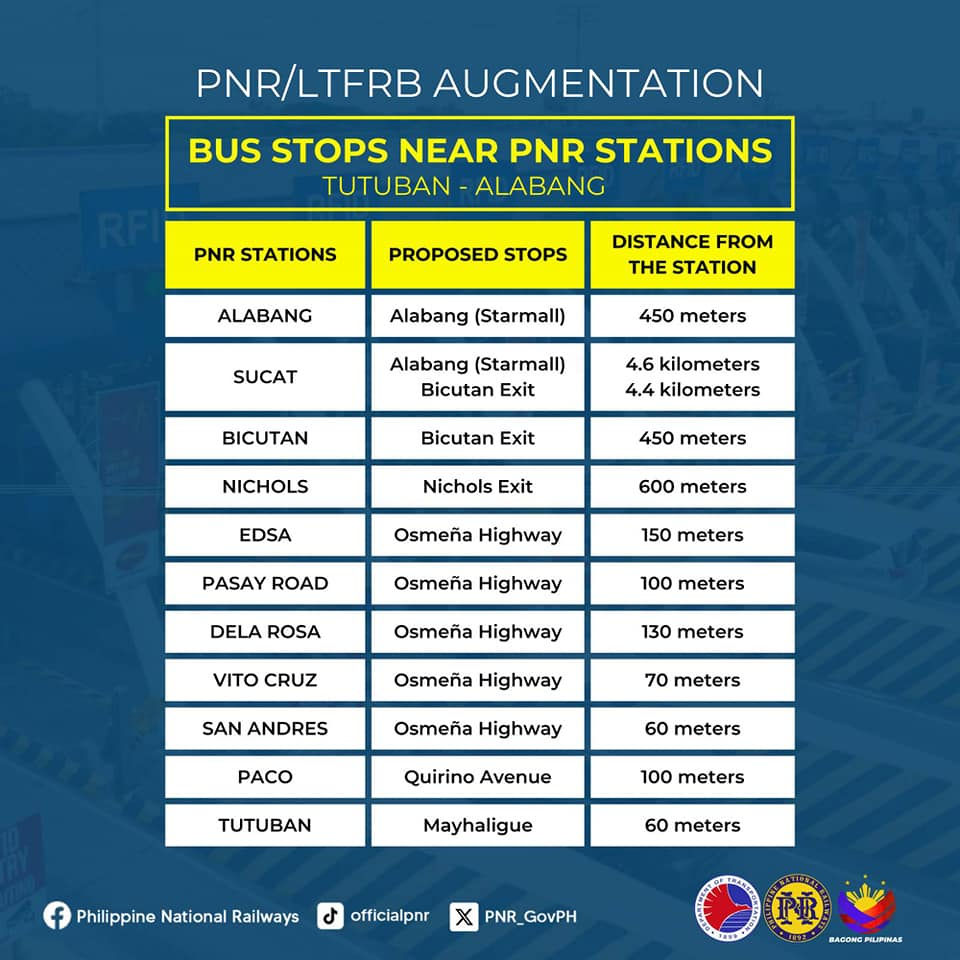
Photos from the Department of Transportation/Facebook
As for the current employees, Regino said that the five-year closure of the PNR had the biggest impact on the operations team, as 306 personnel will lose their jobs according to an article by ABS-CBN.
“Ang pinakamalaking nag sasakripisyo po rito sa suspensyon ng PNR ay ang mga kawani ng PNR at kanilang mga pamilya. At kami po rito, sa pamunuan ng DOTr, sa pamumuno ng ating Secretary Bautista, sa pamunuan po ng PNR…kami po ay sumasaludo sa sakripisyo ng mga kawani at pamilya ng PNR,” he said, expressing his gratitude to PNR employees.
Regino laid out plans for the employees and explained that the workers have the choice to be deployed at the Southern Tagalog station to Bicol Station for 11 days every first 15 days of the month and will provide shuttle services for the remaining four days to bring them home to their families for the remaining 22 days of the month as a resting period.
The undersecretary added that compensation packages and inconvenience allowances will be provided to employees who desire to remain working in Manila.
For minimum wage earners, DOTr and PNR allotted a budget equivalent to the employees’ salary of four months, along with a compensation package and a P10,000 inconvenience allowance.
Employees whose salaries are above the minimum wage will be given two months equivalent of their salaries on top of the inconvenience allowance and compensation package.
The transportation sector, together with the PNR, will also provide an extra P10,000 allowance for people with disabilities, senior citizens, single parents, and employees with dependents.
On top of inconvenience allowances, DOTr and PNR will also provide an employment secretariat, where placement committees will hand the employees’ resumes out to contractors of NSCR and other railway projects to have them prioritized for employment.
Regino stated that a livelihood component will also be provided, where the Philippine Rail Institute will give free training to displaced workers.
“Muli po, kami po ay humihingi ng paumanhin, at sabayang pag-saludo po sa inyong mga kawani ng PNR. Hindi po madali para sa aming lahat ito, na mag-desisyon na suspindihin ang operation ng limang taon ng PNR... Ang susunod ho sa PNR na makikita natin dito, from Clark to Calamba, ibang PNR na po --- [a] PNR that is elevated,” Regino said.
- Jewyz Ann Bunyi & Hyacinth Kate Villanueva


Comments