

From streets to rights: DSWD’s ‘Oplan Pag-abot’ targets more humane outreach operations
- The Manila Warden
- Apr 12, 2024
- 4 min read

March 8, 2024
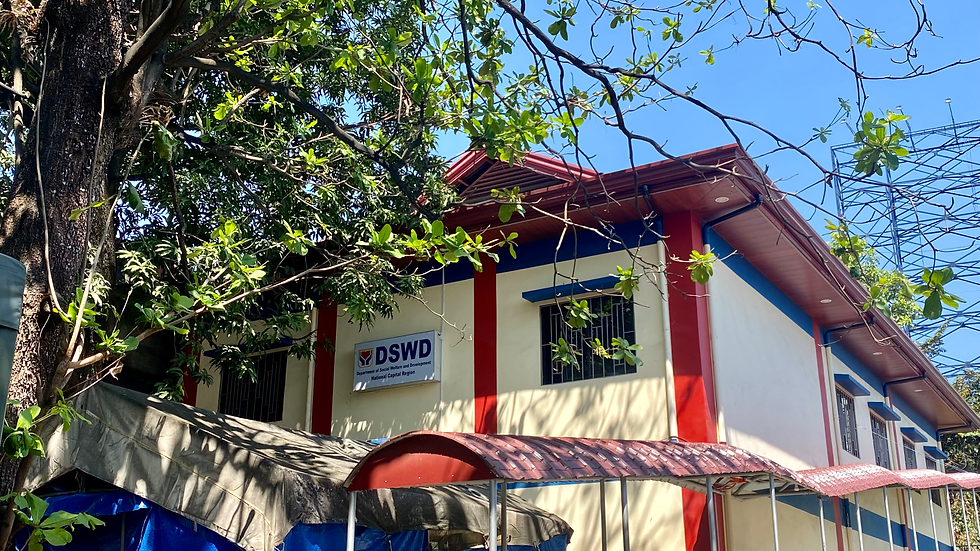
The Bahay Silungan Community Center NCR in Project 4, Quezon City, launched by the Department of Social Welfare and Development on July 3, 2023, shelters families, individual adults, and street children. (Photo by Jewyz Ann Bunyi/The Manila Warden)
A social worker underscored that the new institutionalized Oplan Pag-Abot Program of the Department of Social Welfare and Development (DSWD) would focus on a more coordinated, long-term approach to keeping families, children, and indigenous people (IP) from loitering on streets without violating their human rights.
Mark de Asis, a social worker from Bahay Silungan Community Center NCR, mentioned on March 6 that former programs used to forcefully apprehend children and families who were considered an “eyesore.”
“Kung family ‘yan, at ayaw nilang mag pa-reach out, hindi natin sila kukunin. Babalik at babalikan yan ng mga officer natin, ng mga social workers natin to convince them, not to insist. [...] Kailangan may consent — voluntary,” he said in an interview, explaining how the new program works.
Welcoming the issuance of Executive Order 52, the Oplan Pag-abot Program is a rights-based approach focused on offering families and individuals in street situations (FISS) livelihood, relocation, and decent shelter, in coordination with the Commission on Human Rights, Metropolitan Manila Development Authority, and Philippine National Police.
During its pilot test last year, the Oplan Pag-abot started off by reviewing and recalibrating the previous reach-out process, opting for an interagency effort to touch the aspect of human rights.
Unpleasant experiences of passersby from kids along Taft Avenue, like biting or licking their arms, sparked an online discourse on X (formerly Twitter) on how these children should be reprimanded.
“I do believe that there should be sanction[s] for the children so they would still know what is wrong and right. However, these sanctions should focus on reinforcement rather than on punishment,” X user @kofirevs, an observer around De La Salle University Manila, said via direct message to one of the writers.
The program focused on cities like Manila, Quezon City, and San Juan, gathering more clients along Taft Avenue, Pasay, and EDSA.
“Usually, for the Oplan Pag-Abot Project, ang LGUs (local government units) natin have their own initiatives to reach out to the children,” de Asis said, adding that these initiatives were under the LGUs’ jurisdiction.
LGUs have their respective Bahay Pag-Asa, where juvenile delinquency cases would be admitted and assessed, and information on their family and past experiences would be retrieved.
The level of committed misbehavior would then be determined whether it violated the local ordinance and discerned any recurring misdemeanors on the streets.
“Wala na kasi silang pinagkakakitaan. So may times na nag-o-opt sila to do it the other way [as a means of survival],” de Asis said, mentioning instances of children spitting on jeepney passengers when not given alms.
The children and FISS would be relocated to new community centers like the Bahay Silungan Community Center, which was launched last July 2023.
In 2023, the Bahay Silungan Community Center, which focuses on housing individual adults, had five street children, along with their families, under their care; three of them were from Manila.
Not enough?
A 14-year-old street kid, who roams along Dapitan Street in Manila, expressed her disapproval of being admitted to any DSWD facilities.
Rosa, not her real name, would wander the streets with her three other siblings, the youngest being a 13-month-old infant, while her parents worked in Quezon Avenue in Quezon City.
“Ayaw po kasi namin dun (DSWD) kasi po yung pagkain dun ‘di sapat sa amin eh. Kulang po,” she said.
She added that the P200 they collect by the end of the day is enough to feed her family of six.
At a young age, Rosa saw her peers getting dragged by authorities while she and her siblings would run away from them.
She and her siblings were rescued by officials twice and brought to a facility in Marikina, where they were fed and cared for, but it was insufficient for them.
X user @Altrantalluwant, a victim of an aggressive street children incident, said that cultivating the children into becoming more than their status and situation will get them off the streets.
“If I keep saying “protection” then it’s only for us, ‘di ba? Pero the problem is beyond that. [...] So give them (street children) something more meaningful, more worthwhile. View them as kids and as human beings instead of “pests” or whatever,” she said.
X user @kofirevs said that the DSWD was lacking in resolving the issue.
“Ano ba ang pinaka kailangan para ma-achieve ang self realization? Placed at the bottom of this is food, security, etc. [...] Hence hindi talaga ma-aachieve ang let’s say “proper and moral” actions kung in the first place wala silang (street children) basic needs,” she said.
However, de Asis from DSWD said that they ensure catering to the physiological needs of the rescued children and families by providing basic needs such as shelter, food, and clothing.
“May tinatawag tayo na rehabilitation team. We have the nutritionists and dietitians, social workers, medical officers, the nurses, psychometricians, and the house parents. So tinitingnan ‘yung overall aspect ng bata, not only the bata, but also the parent,” he added.
Bahay Silungan, according to de Asis, though equipped with assessing the physiological needs of children and families, does not provide educational facilities since it mainly focuses on adults and families.
However, the DSWD prioritizes education as few rehabilitation centers in other locations have alternative learning system facilities.
The agency also prioritizes rescued children to reunite with their families after their probation period in the facility. In some cases, however, it differs.
“Kung individual ‘yung bata na pumasok, then that’s the time we can assess. ‘Pag ‘di pa ready ang family nila sa province[s] hindi natin sila itatransfer. Usually mag eextend siya pero continuous ‘yung probation natin ng services na akma. Parang tinetailor fit kasi natin. Hindi pwedeng generalized ‘yung approach natin,” de Asis said.
The Social Welfare Development Department becomes the temporary legal guardian of the children admitted to their facilities.
Children below the legal age with no family cannot be discharged until they turn 18.
“‘Pag batang walang family kasi, mas lenient ‘yung pag-tingin sa patient. Kailangan talagang ichunk ‘yan. Titingnan ‘yan every aspect,” de Asis added.
The Republic Act 10158, an act decriminalizing vagrancy, was enacted to stop the arbitrary arrest of street children by police officials.
Before RA 10158 was approved by the late president Benigno “Noynoy” Aquino III in 2012, Article 202 of the Revised Penal Code labeled a person who loiters on public and semi-public buildings or places as a vagrant and may be subjected to arrest.
Prior to the enactment of the Anti-Vagrancy Law, RA 9344 in 2006 was legislated where section 58 of the law states that people under 18 years old will not be prosecuted for the crimes of prostitution and vagrancy under Section 202 of the Revised Penal Code, mendicancy under Presidential Decree 1563, or sniffing rugby under Presidential Decree 1619.
- J.A.B. & H.K.V


Comments